Air Movers Increase Productivity and Reduce Moisture Levels on Job Sites

In the construction industry, where busy job sites are filled with various equipment, it is crucial to provide a safe, efficient, and comfortable work environment for the workforce. The work environment has a significant impact on productivity, and one key element for optimal conditions is ensuring proper ventilation. That’s where air movers like ventilators, portable air conditioners, and construction fans play a crucial role in creating a better working environment.

An Overview of Air Movers and Their Role in Ventilation

Air movers are specialized equipment designed to propel air within a building or an enclosure. They are utilized to maintain good air quality and ventilation, particularly in places like construction sites, warehouses, and factories.

Three common types of air movers seen on construction sites are portable air conditioners, construction fans, and ventilators.

Portable Air Conditioners

Portable air conditioners are highly useful on construction sites for various reasons.

  • Personal Comfort: Portable AC units provide fast cooling relief for workers, especially those in construction trailers, tents, and temporary offices, making their environment more comfortable and less heat-intense, particularly during hot weather.
  • Improved Efficiency: The use of portable air conditioners can aid heat-intensive work processes like welding by creating a cooler work environment, potentially improving the efficiency of these processes.
  • Faster Drying Times for Materials: Portable air conditioners accelerate the drying process more effectively than fans or dehumidifiers. They speed up the setting and curing of construction materials such as drywall compound, grout, caulking, paints, and adhesives.

Construction Fans

Construction fans offer many benefits on a job site.

  • Improving Heat Safety: Construction fans create a continuous air movement that cools down the working environment. This reduces health and safety hazards related to heat, particularly for workers wearing protective clothing. Fans engineered for construction sites can make workers feel up to 10°F cooler, reducing the risk of heat-related illnesses and maintaining a focus for safer operations.
  • Enhanced Mobility for Customized Airflow: The mobility of construction fans allows them to be transported and positioned flexibly according to the needs of the site and its workers. This ensures that air circulation is optimized across different areas of the construction site, following workers as they move, and providing comfort and safety in various environments.
  • Improving Air Quality: Construction fans can significantly improve air quality on construction sites, where dust, dirt, and potentially harsh chemicals are often present. The fans work by turning over the air several times per hour, creating uniform air distribution and helping to dilute any harmful gasses dispersed in the air. This can lead to improved focus and health conditions for the workers.

Ventilators

Ventilators improve air quality on construction job sites, particularly in underground construction scenarios, by supplying fresh air and preventing dangerous or harmful accumulation of dusts, fumes, mists, vapors, or gasses.

  • Reducing Hazardous Exposure: Ventilators effectively reduce workers’ exposure to hazardous substances, particularly in confined spaces. They operate by forcing fresh air into the area while simultaneously extracting harmful air pollutants. This constant air exchange significantly minimizes the risk of inhaling harmful substances, thus boosting safety measures on the construction site.
  • Enhanced Productivity: By ensuring a continuous supply of fresh air, ventilators can improve the overall work environment. Workers are less likely to experience fatigue or discomfort from poor air quality, therefore enhancing productivity levels and the quality of work produced.
  • Versatility and Adaptability: Ventilators come in various types and sizes to cater to different construction needs. For example, axial fans are perfect for general air movement, while centrifugal fans are best for areas with dust or fumes. Such diversity allows for targeted solutions, addressing unique requirements of specific sites or tasks.

Improve Air Quality in Areas That Have Experienced Flooding

In the aftermath of flooding, air moving equipment like blowers and construction fans prove to be invaluable tools for construction workers. These devices aid in quickly and efficiently drying out waterlogged structures, preventing the growth of mold and mildew, which could pose serious health risks. Moreover, they expedite the drying of soaked materials, reducing project delays and allowing work to resume faster. The use of air movers in such scenarios not only ensures the health and safety of the workers but also significantly reduces downtime, contributing to project efficiency.

Air Moving Equipment from The Pro Group

Portable Construction Air Conditioners

The HSC-14P is a portable 1.2 Ton spot cooler by Airrex. It operates in temperatures ranging from 65°F to 113°F, using an eco-friendly refrigerant. With a cooling capacity of 13,600 BTU, it features cold air discharge nozzles, swivel casters, and a HEPA air filter. The unit comes with a 1-year warranty and offers optional accessories like a condensate pump.

Construction Fans (Blower Fans)

The TPI PB 36-D is a 36-inch direct drive portable blower fan. It operates on a 120V, single-phase power supply and draws 5.5A of current. The motor is a 1/3HP permanent split capacitor type and is permanently lubricated. It is a 2-speed model, unlike the larger 42″ model that is 1-speed.

The 36″ and 42″ models have the capability to swivel 360° in 12-1/2° increments and lock in place with a steel locking pin. It meets OSHA standards and comes with a 1-year limited warranty.

Velocity Ventilators

The VAF1500 A/B is your ideal workhorse for small confined spaces. Whether it’s manholes or sewers, these compact blowers ensure maximum airflow, creating a safe, comfortable, and controlled work environment. Rely on the VAF1500 A/B models to provide a continuous flow of fresh air for your construction, utility, or telephone crews. If you need more power, the VAF 3000 offers more than double the CFM rating in a compact size.

Improve Your Construction Site’s Air Quality Today with Pro Tool & Supply!

Pro Tool & Supply offers a wide range air moving equipment for sale or rent. Contact us today to explore our selection of ventilation solutions for your project.
How to Utilize Construction Dust Containment Solutions

Construction-related fields like remodeling, renovation, demolition, and restoration need to be concerned with construction dust containment. Since 2017, OSHA has required construction employers to limit their employees’ exposure to respiratory silica dust.

Respiratory silica dust is emitted into the air when construction workers drill into crystalline silica-containing materials (concrete, stone, and mortar). Workers breathe in the minute particle dust that has the potential to cause lung damage over time.

Along with dust containment solutions like ventilation and wet methods for cutting and sawing (as explained on the OSHA website), ZipWall and Poly America products help with dust protection. Let’s take a closer look at the dust protection products from these companies.

ZipWall’s Dust Containment Solutions

Zipwall Dust Solutions

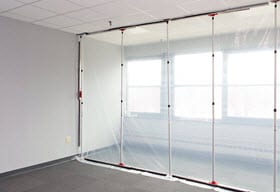
ZipWall manufactures several items that you can use to contain dust in a smaller area. The solution consists of plastic sheeting (or reusable panels) held in place with poles and rails.

The poles and rails brace sheeting tightly in place against the ceiling, floor, and walls, which limits dust exposure to other workers. Here’s a summary of the key pieces of ZipWall’s construction dust containment solutions:

ZipPoles

ZipPoles are braced every ten feet between the ceiling and floor to hold the sheeting in place. They are spring-loaded and extendible to achieve a very tight fit. Different pole lengths (10, 12, or 20 feet) accommodate different ceiling heights.

FoamRail Spans

Install spans between ZipPoles horizontally (at the ceiling and floor) and vertically (along walls). This helps to form a tapeless seal all around the dust containment barrier.

Spans are available in the following widths:

  • 2’3” to 4’ (expandable)
  • 3’ (wall mount kit)
  • 4’ (as a 2-pack)
  • 4’ 3” to 8’ (expandable)

Note: Use the FoamRail Spans with the ZipWall SideClamps or SideBridges along the sides to make a secure seal.

Heavy-Duty Zippers

To create a door in a dust barrier wall, attach the length of the two heavy-duty zippers, beginning at the floor. Keep the zippers parallel to each other and about 3 feet apart. Affix the zippers to the barrier material with the self-adhesive and use a special ZipWall cutting device to cut slits behind each zipper.

Magnetic Door Kit

Use the magnetic door kit to cover up an entryway that doesn’t have a door (or create an entry in a plastic barrier). It has a single opening for people to pass through, but it remains closed with sewn-in self-closing magnets.

Protect Equipment and Tools from Silica Dust

Dust containment solutions can help extend the life of your equipment and tools. Flying dust can settle on greased areas and cause damage over time.

Poly-America Sheeting for Construction Dust Containment

The Poly-America company manufacturers several different types of plastic sheeting that work well for dust containment:

  • 4ml 9 feet 4 inches x 100 feet (fire retardant)
  • 4ml 10 feet x 100 feet (fire retardant)
  • 4ml 20 feet x 100 feet
  • 6ml 20 by 100 feet

Any thickness of plastic sheeting will contain dust, and it may be tempting to buy something thinner at a lower cost. However, the thicker 4ml and 6ml will stand up better to the activity around a job site.

Get Quick Quotes on Dust Protection Products

Visit our website to learn more about dust containment products like dust collection systems. While you’re there, look at other types of sheeting and tarp that can make your jobs easier.

By containing dust in a smaller area, dust protection products can help keep workers safe and prevent damage to your equipment and tools. Another benefit is that you’ll have less cleanup and happier clients. Pro Tool would be glad to provide you with a quote for ZipWall or Poly-America sheeting!

Construction Guide to Winter Safety Products

A slip-and-fall incident takes a split second, but its repercussions can be long-lasting. Slip-and-fall accidents increase in number with our Northeastern winter weather, but it doesn’t have to be that way for you as long as winter safety for construction workers and others is top of mind.

The best way to have peace of mind? Stock up on winter safety products and use them wisely and regularly.

This article focuses on how three types of products can help keep workers and visitors safe on winter construction job sites: industrial ice melts, snow tarps, and snow and ice removal equipment.

Industrial Ice Melts for Safer Outdoor Surfaces

Ice melt products are forgiving winter safety products. The reason is, they are effective even if you forget or are unable to lay them down before the precipitation arrives.

The most crucial feature of ice melt is the lowest outdoor temperature at which it is still effective. For example, Urea and Peladow melt snow and ice at 15 degrees and -25 degrees Fahrenheit, respectively.

Besides the temperature, you need to consider the areas that require ice melt. The corrosive elements of some ice melts can damage concrete and metal, and the product can also be harmful to bushes and other plants.

Other considerations when purchasing ice melt include the size of the areas you need to cover. You’ll need to calculate the square footage for places like:

  • Driveways
  • Entryways
  • Parking lots
  • Steps
  • Walkways

Finally, think about how you’ll apply the ice melt product. You can easily cover smaller areas by tossing the ice melt from a grain scoop. For large areas, consider a commercial-grade ice melt spreader.

Snow Tarps to Stay One Step Ahead of Winter

Using snow tarps is another way to outwit Old Man Winter. These tarps catch the snow as it’s falling, making it simple to haul away.

Unlike ice melt products, the heavy-duty, reinforced snow tarps don’t work unless you lay them before it snows. After the snow is over, slip the tarp’s outer loops onto a front-end loader or other heavy equipment. Then, lift the tarp away along with hundreds of pounds of snow.

It is important to choose a high-quality snow tarp that will last many years:

  • Weather-resistant
  • Mildew-resistant
  • Tear-resistant
  • Heat-sealed and reinforced edges
  • Heavy-duty lift straps

When it comes to fighting snow, ice, and cold, snow tarps are just the tip of the iceberg! You can also use other winter protection products like heating pads, reinforced sheeting, and curing blankets to keep concrete, equipment, and workers warm.

Clear Snow and Ice by Hand or by Machine

construction-winter-snow-removal

Despite our best efforts, it’s not always possible to outwit Old Man Winter. Sometimes you’ll need to remove snow by hand or machine with construction snow removal equipment and tools.

Skid-steer and wheel loaders are invaluable for removing the huge mess that storms leave behind if you usually have large construction job sites. Just make sure you have the appropriate snow shovel attachments.

For small parking lots and walkways, professional-grade snow blowers work the best. And for tight areas like entryways, a simple shovel gets the job done quickly and efficiently.

Improve Winter Safety for Construction Workers

With all the dangers that winter weather presents to you, your workers, and job site visitors, it’s essential to stock up on winter safety products. You’ll also appreciate how much faster the job goes when you don’t have to spend time removing snow and ice.

Pro Tool would be glad to help you choose what’s necessary as well as what’s nice to have for harsh winter weather. We have information on all of the items mentioned above, plus a lot more winter products to keep the snow, ice, and cold at bay.

Whether it’s industrial ice melt or construction snow removal equipment, the knowledge and products are at our fingertips! Contact us, and we’ll get back to you as soon as possible with quotes and answers to your questions!

The Importance of Thermalay Heated Blankets & Electric Heaters

The winter season brings us holiday gatherings with family and friends to compensate for the colder weather. But for those who have to work outside, especially in the northern climates, winter weather is hard.

Heated Blankets and Electric Heaters for a Safer Jobsite

When you work in locations where the temperatures are regularly below freezing, it’s rough on equipment and building materials. Here are just a few of the common problems caused by cold winter weather:

  • Workers are at risk of frostbite, trench foot, and hypothermia.
  • The frozen ground can cause wheeled equipment to skid.
  • Liquid material can separate or freeze solid.

Any of these problems can lead to downtime and missed deadlines. But with the right construction equipment, you can be prepared and avoid these issues.

Heated blankets and electric heaters can protect workers, equipment, and materials. With these two items on hand, you can keep the frigid temperatures from slowing down your construction or renovation work.

All About Thermalay Heated Blankets

Heated blankets aren’t just for mattresses! Construction heated blankets, like those made by Thermalay, have multiple uses on the jobsite:

  • Cure concrete:
    • Concrete needs warmer temperatures to cure properly.
    • Without proper curing, concrete can have quality problems, such as cracking.
  • Heat the ground:
    • Makes digging and trenching easier.
    • Prevents slipping, skidding, and falling.
    • Great to use before laying pavers or other stonework.
  • Maintain material above freezing temperature:
    • Prevents liquid material from separating or congealing.
    • Keeps shingles, gravel, and sand from freezing and sticking together.
 Tip: Don’t lose precious daylight time thawing out the ground, material, or equipment. Before leaving the job site at the end of the day, lay the heated blankets down overnight. 

How Thermalay Heated Blankets Are Constructed

Thermalay heated blankets are constructed with all four edges of the blanket sealed. This keeps the warmth in the blanket and repels moisture, snow, and ice.

The blankets have several layers comprised of:

  • Heated coil elements
  • Micro foam insulation
  • Waterproof reinforced PVC

What You Should Know About Construction Electric Heaters

An electric heater works by blowing air over a heated coil. The coil heats the air as it passes through it.

wide variety of construction electric heaters are available (such as forced air, infrared, and propane). However, electric heaters are popular on construction jobsites because they:

  • Are easily moved from one location to the next
  • Raise the temperature from 30 – 90 degrees (depending on the BTU rating)
  • Move warm air to different indoor areas with a building’s duct system

How to Choose an Electric Heater

When choosing a heater, you’ll want to consider:

  • The highest level of temperature you’ll need
  • The size of the areas you need to heat

In general, the higher the heater’s BTU rating, the higher it can raise the temperature. Before purchasing or renting a construction electric heater, make sure the proper electrical outlet is available for the heater.

The two most common style of electric heaters include the milkhouse and salamander.

Milkhouse-style heater:

  • Easy to carry
  • Good for heating small rooms

Salamander-style heater:

  • Better for large rooms
  • Has wheels for easy portability

Keep Workers, Equipment, and Material Toasty Warm

It takes a few extra steps to keep your workers, equipment, and material warm during the winter season, but it’s worth it. Besides being safer, your workers will be more comfortable. They also won’t have to deal with the frustration of ruined work materials or damaged equipment.

A smoothly running jobsite helps you build a good reputation. A business that is known for meeting deadlines on time and under budget will never be short of work!

The Importance of Sheeting and Tarps on the Job Site

The construction industry has benefited enormously from the fabrication of many different types of construction tarps, snow tarps, and sheeting. Used to improve safety and protect from the elements, these products are a must-have for your construction equipment list.

This article describes the features of these different kinds of sheeting and tarps and how they are used on the job site.

Protect Workers and Passers-by with Debris Netting

High-density polyethylene material (HDPE) is a thermoplastic material known to be lightweight but also strong. For this reasons, it’s an excellent material to knit into a type of construction tarp—debris netting.

The Eagle Industries debris netting that Pro Tool stocks is tested to withstand rigorous conditions on a construction jobsite. Its UV protection prevents the material from degrading due to sunlight exposure.

The grommet edges and reinforced webbing make it easy for workers to install around multi-story buildings as well as floor and elevator openings. Your worksite is much safer when can prevent tools being dropped or equipment slipping over edges.

The debris netting mesh is available with either 1/16” holes (standard) or 1/32” (premium). You can also purchase it as flame-retardant per NFPA 701.

 Important!Debris netting is strong, but it’s not meant to prevent personnel from falling. For that function, look for personnel safety netting and safety nets. 

Scaffold Sheeting Shields Workers from Sun and Wind

When compared to working on the ground or inside a building, workers on a scaffold are more exposed to the elements. Therefore, it’s important to shelter them with a type of construction tarp called scaffold sheeting.

When adding to your construction equipment list, look for scaffold sheeting that has grommets along the edges, which makes it easier to attach the sheeting to the scaffold. Depending on the type of work you’re doing, you may also need to use non-flammable sheeting.

Other uses for scaffold sheeting:

  • Surround and protect storage areas
  • Wrap site and work perimeters
  • Protect workers and public from debris

Pro Tool carries scaffold sheeting from several manufacturers. Two of them are Monarflex and Eagle Industries:

  • Monarflex Super T-Plus Flamesafe is made from Supertough LDPE:
    • 8-mil
    • Available in 7’4” X 137’ or 13’ X 157’
    • Flame-retardant polypropylene
    • Grommet system
  • Eagle Industries Scaf-Lite™ is a premium-grade, string-reinforced, polyethylene sheeting:
    • 6-mil or 12-mil
    • Available in 7’4” X 136’ (6 mil) or 13’ X 100’ (12 mil)
    • Eyelet bands on edges with reinforced holes spaced every 4”
    • Water and mildew resistant

Snow Tarps Simplify Snow Removal

When you live and work in cold-weather states, removing snow and ice from work areas and pathways wastes time and energy. To keep your work on schedule no matter the weather, use snow tarps.

Made from 18 oz. PVC-coated vinyl fabric, Eagle Industries snow tarps are reinforced with two-inch wide yellow webbing. Loops of the same webbing are spaced evenly around the perimeter (either four or eight loops).

Here’s how it works:

  1. At the end of the day, lay the tarps down over the areas you want to protect.
  2. In the morning, attach the loops of the tarps to a front loader or crane hook.
  3. Use the heavy equipment to lift the snow-laden tarps away.

Pro Tool carries this brand of snow tarp in 20’ x 20’ and 25’ × 25’ dimensions.

Complete Your Construction Equipment List with Sheeting and Tarps

Protect your workers, equipment, and storage items with debris netting, construction tarps, and snow tarps. Invest in long-lasting material for a safer and more comfortable worksite.

Let’s talk about your construction equipment needs:

  • Call Pro Tool at 1-844-671-2956
  • Contact us with questions
  • Request a quote

We look forward to hearing from you!

OSHA’s Job Site Fatal Four

Naturally, construction safety is the primary focus during Construction Safety Week (May 3 – 7). This weeklong occasion emphasizes the importance of keeping yourself and your workers on and around the job site safe.

Construction Safety Is a Big Job Site Concern

Unfortunately, the construction sector remains one of the top 10 most dangerous workplaces. In 2019, it ranked among the top 5 for the highest incidence of workplace injuries. For this reason and many others, Construction Safety Week is a yearly reminder to:

  • Refresh what you know about safety best practices
  • Make sure your existing safety equipment is in good shape
  • Check out new safety equipment

But remember, if you’re serious about reducing the number of injuries on your worksite, you must keep safety at the forefront every single day—not just one week out of the year. To help you with this, our article discusses in-depth the four most common types of job site accidents, known as the fatal four.

Job Site Safety and the “Fatal Four”

Nearly every single construction job site accident you hear of or read about is preventable! To increase safety, you and your crew need to be aware of dangerous scenarios and behavior.

Let’s first see if you can remember what OSHA defines as the top “fatal four” accidents:

  • Falls
  • Caught-in or -between
  • Struck-by
  • Electrocution

Falls Are the Most Common Job Site Accident

We’re listing this first because construction falls contribute to more fatalities each year than all other Fatal Four hazards combined. This section deals with falls from different heights (as opposed to falling from a slip or trip.)

An injury from a fall can occur when working at a height of four feet or more. Areas to watch out for include:

  • Edges of roofs and stories
  • Floor openings (stairwells and skylights)
  • Makeshift scaffolds
  • Portable ladders

The best protection for workers is an awareness of where they are at all times. Every day, inform your workers of new areas around which to use caution.

The next level of protection is with job site safety gear and equipment. Workers can use harnesses, lifelines, anchors, and lanyards. Also, improve job site safety by marking dangerous edges with safety netting and perimeter warning lines.

Caught-In or -Between Job Site Accidents

The caught-in or -between accidents are not as obvious to spot and prevent as falls. These types of accidents occur when a person:

  • Is buried in a hole (or trench)
  • Is trapped between two objects (a wall and equipment)
  • Gets clothing or body parts caught in a piece of machinery or equipment

Job site areas to watch out for include:

  • Gaps between equipment and stationary objects (walls or other equipment)
  • Unsupported holes and trenches
  • Pinch points on machinery (running belts, unguarded saws, rotating parts)

Struck-By Involves Dropped or Collapsing Objects

Struck-by accidents occur when an object strikes a person. The object can be a construction tool or debris that falls onto a person. With a struck-by accident, even walls made of concrete or masonry blocks can fall on a worker.

What’s the difference?

This type of accident is different from the caught-in and -between accident because the person is not trapped between a moving object and a stationary one (or between two moving objects). Instead, something falls onto them.

To reduce struck-by accidents, use caution in the scenarios:

  • Near heavy machinery or equipment on inclines
  • Beneath overhead work or large loads of material
  • Near an edge while using tools and equipment
  • Around block walls that are actively being built

To reduce the potential for injury, all workers should wear hardhats to avoid being struck in the head. To further improve job site safety, use debris nets to catch falling objects. Even better, use toe boards and guardrails at the edges to catch objects before they fall.

Electrical Accidents Cause Burns, Shocks, and Worse

Electrical hazards put workers at risk for electrocution, burns, shocks, fire, explosions, and arc flashes and blasts.

Electrocution

A lethal dose of electricity to the human body causes a fatality.

Burns 

Serious burns can come from the shock itself, an arch/flash, or thermal contact.

Shocks

Although an electrical shock might not be lethal, the shock can cause the worker to fall from a height.

Fire

Sparks from electrical equipment can start a job site fire.

Explosions

Explosions can occur when a dangerous mix of material is in the air and a spark of electricity sets it off.

Arc Flashes and Blasts

These happen when electrical energy is suddenly released through the air. It gives off an extreme level of heat and intense, bright light that can cause burns.

To avoid electrical accidents, watch out for:

  • Overhead and buried power lines
  • Energized equipment or machinery with damaged/bare wires
  • Buildup of conductive dust/corrosion
  • Old wiring (or “fixed” wiring) and problems with plugs, receptacles, and switches
  • Power and extension cords used improperly

Construction Safety Is an Ongoing Choice

With so much happening on the job site, it takes extra effort to remain aware of the dangers. Being fully prepared on the job site is an everyday concern that ensures you and your workers will return home safe and sound at the end of the day.

Pro Tool is eager to help you make the right choices when it comes to the proper signage and protective equipment. Don’t wait for Construction Safety Week to ensure your job site’s safety.

To ensure you’re never short on the right kind of safety equipment, check out our list of 9 safety products to always have on hand. Also, we invite you to see how seriously we take safety at Pro Tool & Supply, as well as our full inventory of safety equipment.

9 Construction Safety Products to Always Have Available

Safety on the job site is more important than ever. To keep workers safe, you cannot overlook any precaution. All construction safety products play an equal part in keeping workers and civilians safe.

Hygiene

Keeping hands clean is the number one way to stop the spread of illness. These two construction safety products are great for cleaning hands on a construction job site:

  • Portable Sinks: No plumbing or running water? No problem! Portable sinks are available with or without a hot water heater and can hold up to 5 gallons of water. All that you need is a standard outlet to plug it into.
  • Hand Sanitizer Station: If portable sinks aren’t feasible, hand sanitizer stations are the next best thing. Look for a stable and easily movable design. The best places for hand sanitizer stations are by communal areas like entrances, exits, latrines, and break rooms.

Personal Protective Equipment

Personal Protective Equipment (PPE) safeguards workers from contagious illnesses as well as worker injury.

  • Head (hard hats, safety helmets)
  • Eyes (safety glasses, eye wear lanyards)
  • Ears (ear plugs, headphones)
  • Face (face shields, respirators, dust masks, welding and metal pouring masks)
  • Body (safety harnesses, hi-visibility vests and jackets)
  • Hands (gloves for welding, cut protection, and general protection)
  • Feet (boots)

Fire Protection

Fire extinguishers and detectors are well-known construction safety products. However, you may not know about material that is fire-resistant, such as:

  • Scaffold tarp
  • Reinforced woven poly
  • 4 mil poly

If your job site includes areas where sparks from welding and other equipment is common, these materials are worth looking into.

Gas Detection and Storage

Cabinets for storing gasoline are a must on the job site, both for security reasons and fire prevention. Besides being fire resistant, some cabinets are available with locks. Once they’re protected in a cabinet, you can store them in convenient areas, like next to where they are needed!

Another construction safety product, the fire extinguisher stand, prominently displays and lifts the flame retardant container, making it more visible and accessible. If you don’t use a stand, you can mount extinguishers vertically or horizontally on the wall to keep them in reach.

Also, if your work trailer or office is located close to heavy equipment, fire detectors that include a carbon monoxide alarm are recommended.

Ladders

At first, ladders might not seem like a construction safety product. However, they help workers reach the heights they need without stretching or getting off-balance. Make sure you get the right ladder for the task:

  • Step ladders: These A-shaped ladders are typically made of fiberglass. They’re non-conductive and safe for doing electrical work. Some ladders have slots at the top to hold your tools, which removes the need to wear a clunky toolbelt.
  • Twin-step ladders: A close cousin of the step ladder, the twin-step allows two people to climb at once from either side of the ladder. They are usually made of fiberglass.
  • Extension ladders: Taller extension ladders can reach up to 40 feet. Although this is quite long, the aluminum material keeps them durable and easy to carry. You can also find extension ladders made of fiberglass.
  • Podium ladders: The podium ladder has a large platform at the top, which makes it easier for standing for longer periods of time. Some are available with a safety rail to prevent falls or have slots to hold tools.

Safety Tip: Use construction storage to keep construction safety products secure and easily available. They’re available in many sizes to serve as simple tool storage areas or as an entire mobile office.

Lighting

The right kind of light can help prevent tripping and other accidents. Your lighting needs can vary from simple LED light strings to towable light towers. The great thing about these types of safety construction products is that they’re all portable!

When stocking up on lighting, remember replacement bulbs, power cords, and adapters. You’ll also want to consider if you’ll need to supplement the energy source with power blocks or wiring devices.

Fencing

Construction fencing is the literal barrier between the job site and civilians. With so many people walking and driving in a distracted manner nowadays, a strong safety fence could save someone’s life.

Additionally, depending on your location and the season, a snow fence can be an important construction safety product. It keeps snow from drifting into work areas, where it can cause workers to slide and slip.

Caution Signage

Along with fencing, safety signage keeps civilians safe by directing them away from construction areas. However, it also keeps workers alert to danger by pointing out hazardous areas (with caution tape) and the edge of upper-level structures (with perimeter flagging).


Safety Tip:

You never have too much experience to learn more! To keep safety high on the list, check out safety training classes.

Simple But Necessary Safety Items

Some construction safety products are so common that you may not realize you’ve run out of them or they’ve worn out. This includes items like first aid kits, flashlights, and two-way radios.

Eyewash stations may be required on your job site depending on the chemicals that you use. If snowy, inclement weather is common in your area, make sure you stock up on ice melt. And finally, to protect workers from shocks caused by worn wiring, make sure you have electrical tape on hand.

Safety Experts Standing By

To successfully complete a job, you need to be fully prepared to perform any task within OSHA regulations. By doing so, you’ll keep employees as safe as possible.

The Pro Group stocks hundreds of ANSI-approved construction safety products. We’d love to show you more about construction safety best practices and provide advice on how to efficiently maintain a safe environment. If you have questions or a specific need, contact us online or call your sales rep.

Construction Site Noise Control Management

Construction sites are known for being loud, but excessive noise is not something workers and neighbors just have to deal with. As with any health and safety issue, construction site noise control is everyone’s responsibility. The Occupational Safety and Health Administration (OSHA) reminds construction professionals that construction noise is a preventable cause of permanent hearing loss. Exposure to loud construction noises poses other concerns, such as making it difficult to communicate safety messages with co-workers or hear approaching vehicles. Fortunately, there are several construction site noise control measures and devices you can implement to protect workers and the public from harm.

Protection for Workers

Worker protection from the perils of construction site noise comes in two forms: mitigation and personal protective equipment (PPE). Taking steps to tone down the noise before it reaches workers’ ears is the best option. Prior planning of work assignments and worksite layout is the first step. Scheduling the loudest activities during times when fewer workers are on the site is one effective strategy.

Operators of circular saws, belt sanders, and nail guns, and other loud equipment, of course, cannot put distance between themselves and their hand tools. But they may be able to isolate themselves from others. Extension cords give workers a wider range of workspaces. Similarly, generators (use the smallest, quietest available that will still get the job done), pumps, and other stationary equipment can be shielded with noise reduction barriers.

Personal protection consists of shielding ears so loud noises cannot penetrate. Earplugs and earmuffs come in several varieties designed for different duties and durations.

Earplugs fit inside the ear. They conform to each person’s unique ear canal shape, forming a snug seal against construction site racket. Comfort is key, as ill-fitting earplugs may tempt wearers to remove them, defeating their purpose. Workers should find a type and size that they can insert and wear for long stretches:

  • Roll-downs – Worn once and then discarded, these foam plugs are rolled between the thumb and forefinger, slightly compressing them before they are inserted. Once in the ears, they expand, filling the opening.
  • Plastic – Reusable for 10 to 20 days, plastic earplugs reduce waste and cost. Different sizes and shapes allow workers to find a style that offers the best fit, protection, and comfort. Pliable and smooth, they need not be rolled or manipulated before inserting them.
  • Push-In Foam – Designed to combine the softness of foam and the fit and hygienic and environmental benefits of reusable varieties, push-in-foam styles are used for a week on the jobsite before being discarded for a new pair. Their dense foam construction offers better construction site noise control.

Earmuffs fit over the fleshy parts of the ears, using sound-attenuating materials and a snug seal to keep loud noises at bay. Construction workers often prefer earmuffs in difficult environments, as inserting plugs into the ear can transfer dirt and grime to sensitive ear canals. They may not be as effective as earplugs in high-noise areas, however, as the seal around the ears can slip. They can be bulky and heavy, though they can work with hardhats, respirators, and other PPE. Passive earmuffs use foam or other noise-absorbing material to protect the ears. Electronic earmuffs use circuitry to counter the effects of noise. Some can detect decibel levels and block noises above a certain level while allowing “normal” sounds – conversations, warning signals, traffic noise, etc. – to pass through.

Protection for the Public

construction site noise control

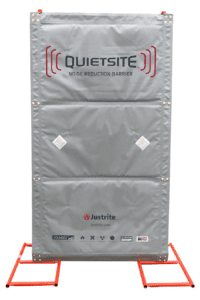
Blocking noise before it reaches people’s ears protects both workers and passers-by. Construction companies, like all businesses, are required to control noise. Non-compliance can result in hefty fines and potentially costly construction delays. Prefabricated panels like Justrite Quiet Site Noise Reduction Barriers absorb and deflect sound at the source, before it can cause damage. The 4-foot by 6-foot and 4×8 modular panels can be connected and configured in a variety of shapes to surround machinery or create a barrier wall between noisemakers and workers and the public. Foldable, stackable, and easily assembled, Justrite’s fire- and water-resistant barriers can be mounted on link fence, scaffolding, or steel frames.

Prolonged exposure to loud construction noises can cause permanent, irreparable hearing loss. Even noises that require workers a few feet apart to raise their voices to be heard are loud enough to cause damage. Contractors need to protect their workers, site visitors, and neighbors from the effects of noise pollution. Erect barriers to contain noise-generating equipment and provide workers with a variety of earplugs and earmuffs to ensure they can find a size and type that is comfortable and effective.

The Pro Group’s technical and sales team members are experts in local noise compliance regulations. Contact us for advice on the products and applications you need to implement a noise-reduction protocol to stay in compliance and protect the people at and around your construction site.

5 Summer Safety Tips for Construction Workers

The hot summer heat can make working uncomfortable. Without the right preparation and equipment, it can also quickly become very dangerous.

Heat exhaustion and heat stroke are not only uncomfortable, but can lead to serious illness or even death. Even less-serious overheating can lead to injuries and accidents affecting other construction workers and property.

As your job sites begin to heat up this year, it’s important to create an environment where construction workers are able to reduce the risk of overheating, heat exhaustion, and heatstroke.

Some methods and tools to keep in mind include:

1. Stay hydrated and have plenty of accessible drinking water

Staying well-hydrated is the body’s best defense against hot working conditions. On-site, make sure workers have ample water on hand, and are encouraged to drink throughout the day.

For long shifts, making sure everyone has a chance to eat is also important for hydration, since both water and salts are a necessary part of maintaining an electrolyte balance.

2. Provide shaded areas for resting

Making sure workers have a chance to avoid direct sun exposure during breaks helps to keep workers cool and prevent sunburn and heatstroke.

Having proper equipment and supplies, including cooler mesh gear where possible, sunglasses, and sunscreen are all also important tools.

3. Take constant breaks

Giving the body a chance to cool down during activity is key during hot weather. Continuous work in the heat is not advisable.

The CDC estimates the amount of break time needed depending on the environmental conditions, air temperature, and type of work being done – for example, doing moderate work at 101 degrees Fahrenheit typically requires 20 minutes of break time for every 40 minutes of work.

You can adjust the work/rest schedule to your worksite, but keep in mind that self-pacing alone may not be sufficient.

4. Learn to recognize the signs of heat-related illnesses

Heat stress is dangerous partly because it can come on suddenly – the person experiencing it may not realize what is happening. Making sure you and your workers know how to recognize signs of heatstroke and heat sickness, and what to do if someone has these symptoms, can be key to keeping everyone safe.

Some signs to look for include:

  • Confusion
  • Dizziness
  • Fatigue
  • Muscle cramps
  • Nausea
  • Headaches
  • Clammy, damp, or pale skin
  • Strange behavior or altered mental state
  • Panting/rapid breathing, rapid heart rate

If someone has these symptoms, they should stop working and seek medical attention immediately.

Some people may be at higher risk of heat-related illnesses due to their age, health history, or other factors.

5. When working indoors, make sure to use construction climate control

Being in an enclosed space can quickly make even mild days feel sweltering. Construction air conditioning and dehumidification are both essential to keep workers safe, cool and productive. The Pro Group carries a range of portable climate control options for sale and rental.

Construction dehumidifiers

Humidity is the presence of water molecules in the air. Warmer air can hold more water than cold air, meaning that warmer temperatures often mean higher indoor humidity.

Your body’s main defense against heat is to sweat, which works because water evaporating off your skin makes you cooler. If there is too much moisture in the air, more water will sit on your skin.

Construction dehumidification is already an important tool for many indoor jobsite environments since damp air can mean poorer drying and curing for many processes.  When it comes to heat protection, making indoor spaces dryer can also make the difference for worker safety.

The Pro Group carries several indoor dehumidification tools, including the DRI EAZ lgr 7000, which offers portable, high-performance water removal at rates of up to 130 pts./day. This option also offers a built-in self-monitoring system which make automatic fan speed adjustments over the course of the day.

Construction air conditioning

When keeping the air dry and moving isn’t enough, air conditioning can also be a helpful tool at keeping indoor spaces habitable.

Pro Tool also carries a number of air conditioning units to fit most indoor construction climate-control needs, including the Americool WPC-4000 which offers a powerful and effective cooling mechanism. This can be especially important in areas where heavy work is being done or surfaces get very hot to the touch.

The Pro Group is here to help you stay cool all summer

Preparing for rising temps is just good business. Climate control results in a safer construction site, but also a more efficient site – overheated workers have less energy and find it harder to concentrate. Keeping things cool is not only safer, but helps to keep projects on schedule.

For help finding the right climate control solutions for your team and your job, our skilled technicians are always on hand. Request a Quote or call us at 1-888-776-0007 to speak with a Pro Tool & Supply representative for more information on our stock of construction dehumidifiers, ventilators, portable construction air conditioners, and fans.

OSHA Compliant Silica Vacuums

Silica is one of the most common minerals found globally. Unfortunately, when it shows up in construction sites as an ingredient in sand, rock, concrete, mortar, and stone, it can also quickly become one of the most dangerous health concerns.

When workers cut, grind, saw, or crush these materials, it generates very fine crystalline silica powder which wreaks havoc on the lungs if inhaled. Silica exposure can then lead to chronic and serious illnesses, like:

  • Lung cancer,
  • Silicosis (an often fatal, incurable lung disease),
  • COPD (chronic obstructive pulmonary disease), and
  • Kidney disease.

OSHA Standards for Silica Dust Protection

Back in 2017, OSHA set a new, stricter standard for crystalline silica dust that cuts in half the previous limit. According to the standard,

“the employer shall fully and properly implement the engineering controls, work practices, and respiratory protection specified”

The penalty for not engaging proper protection also got a lot steeper: as of January 2020, a single violation costs over $13,493, with rapidly escalating fines for repeat offenses up to $134,937 per violation.

In other words, silica vacuums and other respiratory protection tools are not only important for worker health, but also to stay compliant and avoid a critical financial hit.

Pro Tool and Supply carries a number of top brands of OSHA-compliant silica vacuums

Per OSHA standards, if you’re using a dry system to capture dust from floor grinders, the vacuum requires a shroud firmly affixed to the bottom of the grinder to corral the dust, a vacuum powerful enough to suck up the dust, and a filter with 99 percent or greater efficiency and a cleaning cycle.

Pro Tool and Supply carries a range of top OSHA-compliant vacuums and silica dust removal systems to help you comply with the latest regulations.

We are also happy to speak with you directly to help identify the best solution for your needs.

Some of the top brands we carry include:

Dewalt

We carry two Dewalt model dust extractors, including the dwv012 model 10 Gallon extractor and the dwv010 model 8 Gallon HEPA Dust Extractor with Automatic Filter Cleaning.

Both models offer variable suction to control the vacuum’s power consumption and work in wet and dry applications.

This dust extractor is equipped with automatic filter cleaning functionality that pulses every 30 seconds for continuous operation without you having to stop to clean out the filter.

They also come with two HEPA filters and kink-resistant hose. The larger model offers 140 CFM of airflow for maximum suction, while the smaller model is lighter weight and offers 130 CFM.

Both have heavy-duty construction and a 360-degree swivel.

Bosch

Bosch air extractors offer convenient cartridge design to make filter installation extremely easy. We carry two model sizes, the vac013 and vac019. Both include a universal dust collection attachment and on-board filter cleaning, with a maximum of 150 CFM suction and 97 inches of static water lift. The on-board filter activates every 15 sections.

The included fleece filter bag helps to protect the filter and provides the optimal containment of dry dust and debris. The system is universal and is designed to connect to a vacuum so that it can be used with any size hammer and can accommodate the full range of drill bit diameters and drilling depth.

Wap Attix

The Attix 50 wet/dry vacuum cleaner (model 50 (900131h) is the latest compact generation of the Attix line (formerly called WAP).

These silica vacuums are favored by contractors for general clean-up, “at-the-source” dust control during sanding/drilling operations, offering 135 CFM and 92 inches of water lift, a quieter motor with a lower noise rating than other models, and a 12-gallon tank capacity. The Attix also includes a more ergonomic design and convenience features such as a built-in tool storage area on the cover.

Dustless

Pro Tool carries the Dustless Technologies (1606) Wet Dry HEPA 16gallon vacuum, which includes a Micro Pre-filter that extends the life of the filter and makes this vacuum more cost-efficient to use over time. The pre-filter captures particles down to 0.5 micron, before they hit the HEPA 0.3-micron filter, which therefore lasts up to 30 times longer.

The Dustless model also enables switching between wet and dry operation without stopping to change filters or make other adjustments. This vacuum emits only 81 dB of noise, and offers 126 CFM and 76.9 inches of water lift. A 16 Gal. Canister and Micro Pre-filter bag support optimum air flow while holding up to 40 lbs. of dirt and debris.

Husqvarna

Pro Tool also carries multiple models of dustless system vacuums from Husqvarna, including:

  • DC1400

A small and lightweight wet/dry silica vacuum, the DC1400 is perfect for dust control. It’s designed for use with the PG280 Grinder, but can also be used with hand grinders.

  • DC3300

The DC3300 is a single-phase dust extraction unit designed to accompany the Husqvarna PG 530 Grinder.

  • DC5500

The DC5500 is a more heavy-duty choice that’s ideal for use with any planetary grinder that needs a vacuum with high suction and flow to eliminate airborne dust.  The high CFM and large capacity enable it to handle all grinding and polishing applications.

Pro Tool’s Quality Silica Dust Vacuums Get the Job Done Safely

Finding the right OSHA compliant vacuum is essential both for the safety and health of your workers and for the sake of meeting stringent OSHA compliance standards.

Pro Tool offers the highest quality vacuums to get the job done safely and efficiently.

Still not sure which silica dust vacuum is right for you? Call The Pro Group at 1-888-776-0007 to speak with a representative who can help you find the right model for your needs, or request a quote here.

Search For Products

Product has been added to your cart