3 Considerations When Choosing a Concrete Saw

A worker is only as good as his or her tools. It’s a cliché, but only because it’s true. The adage might have been coined with concrete cutting in mind. Choosing the proper concrete saw based on your application is critical. Concrete’s physical characteristics can turn an expensive concrete saw blade into sawdust if it is used in an operation for which it is unsuited.

Concrete Cutting Tips

Whether you use a cutoff saw, walk-behind, block saw, or other variety, there are a number of best practices to observe to achieve the best results and make operation as safe as possible:

  • Cut on Time – In almost every case, after concrete fully cures, it’s too late to cut effectively. It is prone to fracture. On the other hand, concrete that is not fully dry presents its own set of problems. Like Goldilocks, you need to cut concrete when the timing is just right: After it has cured, but before it has hardened. The cut will be smoother and create less dust.
  • Keep it Clean – Speaking of dust, make sure you don’t inhale it. Wear an approved respirator attach a dust shroud, and seal off areas in which concrete saws will be in use.
  • Stay on the Straight and Narrow – For straight cuts, mark the cut path with a chalk line of, if water from wet cutting washes away the chalk, a wax pencil. Clamp a straightedge to the outside of the line as a guide for the saw. Keep a firm grip on the saw at all times to ensure safety and control.
  • Don’t Lose Your Cool – Patience is a virtue when using concrete saws. Allowing the blade to do the work alleviates muscle fatigue and prevents handheld saws from bucking. Don’t force the saw through the concrete; simply guide it along the cut path. Cutting thick concrete with a series of shallow cuts will improve accuracy and keep the saw from overheating. Make several passes, cutting a half-inch to an inch deeper each time through.

Saw Choice

Concrete saws come in a variety of styles, each with its own strengths and weaknesses. Picking the right saw is a function of three considerations.

  1. The Application

As discussed, each type of concrete saw is built for specific cutting jobs:

  • Walk-Behind Saws – These large, cart-mounted saws work on horizontal slabs such as parking lots, home foundations and patios, and airport runways. Use them when long, straight cuts are needed; their heft helps keep the blades in line.
  • Cutoff Saws – Gas-powered hand-held cutoff saws can cut through brick and metal, as well as concrete. Cutoff saws’ portability and maneuverability make them the tool of choice for cutting windows and other openings in precast concrete up to five inches thick.
  • Chainsaws – Resembling chainsaws made for cutting wood, concrete chainsaws are the go-to tool for cuts deeper than the 5 inches a cutoff saw can deliver. They work best when cutting deep, narrow openings. Their strengths also including cutting sharp angles and square corners not possible with circular blades.
  • Early-Entry Saws – Primarily used to cut crack-control joints in uncured concrete, early-entry saws feature plates that exert downward pressure on the cutting surface while blades slice the concrete in an up-cutting orientation to relieve stress on green-zone concrete before it can crack during curing and hardening.
  1. The Blade

Concrete is hard, so concrete saws need hard-edged blades to cut it. And since nothing is harder than diamonds, diamond blades are the preferred method, no matter what type of saw you’re using. With that issue decided, there still are several decisions to be made to determine your best blade option:

  • Compatibility – Choose blades whose diameter and cutting depth are compatible with the saw’s specifications and that conform to the saw’s horsepower and RPMs. Operating a blade with a too-powerful saw risks injury and malfunction, while using a blade at a slower-than-recommended speed will compromise performance and reduce its lifespan.
  • Specialty – Blades designed for cutting green concrete are almost always made for use with early-entry saws. Likewise, while some dry-cutting blades can be use in wet-sawing applications, the reverse is never true. Wet-cutting blades should never be used in dry-cutting operations.
  • Material – Diamond blades work by embedding diamond chips and dust in a matrix that adheres them to the blade. As cutting friction wears away the matrix, new, sharp diamonds are exposed. The softer the matrix, the faster this erosion and diamond replenishment occurs. So, harder matrices use each diamond layer for longer periods, making them the right choice for softer concrete. Softer matrices are the best option for harder concretes (those made of quartz aggregate, for example), because it dulls the diamonds more quickly, so they should be replaced more often.
  1. The Niche

Some concrete saws are manufactured to solve specific issues or meet the needs of particular industry niches. For instance, Husqvarna makes two saws that address issues general concrete cutters often encounter:

  • Husqvarna K 760 Cut-n-Break – This saw trims hours of the time required to cut through thick concrete walls. Its twin blades cut a core into the concrete about three inches deep. A companion tool is used to break off the core, clearing the path for another three-inch cut. Repeat the process until you’ve cut through the slab.
  • Husqvarna K 6500 Ring – This electric saw combines deeper cutting action with less vibration to allow longer operation for extended projects. Capable of cutting up to 10 inches deep in a single pass—double the depth of most competitors—this powerful electric saw incorporates great balance and light weight for excellent user comfort.

Pro Group carries a complete line of concrete saws for every application. Contact our experienced team for help selecting the saw and blade that will work best for your project.
Construction Site Noise Control Management

Construction sites are known for being loud, but excessive noise is not something workers and neighbors just have to deal with. As with any health and safety issue, construction site noise control is everyone’s responsibility. The Occupational Safety and Health Administration (OSHA) reminds construction professionals that construction noise is a preventable cause of permanent hearing loss. Exposure to loud construction noises poses other concerns, such as making it difficult to communicate safety messages with co-workers or hear approaching vehicles. Fortunately, there are several construction site noise control measures and devices you can implement to protect workers and the public from harm.

Protection for Workers

Worker protection from the perils of construction site noise comes in two forms: mitigation and personal protective equipment (PPE). Taking steps to tone down the noise before it reaches workers’ ears is the best option. Prior planning of work assignments and worksite layout is the first step. Scheduling the loudest activities during times when fewer workers are on the site is one effective strategy.

Operators of circular saws, belt sanders, and nail guns, and other loud equipment, of course, cannot put distance between themselves and their hand tools. But they may be able to isolate themselves from others. Extension cords give workers a wider range of workspaces. Similarly, generators (use the smallest, quietest available that will still get the job done), pumps, and other stationary equipment can be shielded with noise reduction barriers.

Personal protection consists of shielding ears so loud noises cannot penetrate. Earplugs and earmuffs come in several varieties designed for different duties and durations.

Earplugs fit inside the ear. They conform to each person’s unique ear canal shape, forming a snug seal against construction site racket. Comfort is key, as ill-fitting earplugs may tempt wearers to remove them, defeating their purpose. Workers should find a type and size that they can insert and wear for long stretches:

  • Roll-downs – Worn once and then discarded, these foam plugs are rolled between the thumb and forefinger, slightly compressing them before they are inserted. Once in the ears, they expand, filling the opening.
  • Plastic – Reusable for 10 to 20 days, plastic earplugs reduce waste and cost. Different sizes and shapes allow workers to find a style that offers the best fit, protection, and comfort. Pliable and smooth, they need not be rolled or manipulated before inserting them.
  • Push-In Foam – Designed to combine the softness of foam and the fit and hygienic and environmental benefits of reusable varieties, push-in-foam styles are used for a week on the jobsite before being discarded for a new pair. Their dense foam construction offers better construction site noise control.

Earmuffs fit over the fleshy parts of the ears, using sound-attenuating materials and a snug seal to keep loud noises at bay. Construction workers often prefer earmuffs in difficult environments, as inserting plugs into the ear can transfer dirt and grime to sensitive ear canals. They may not be as effective as earplugs in high-noise areas, however, as the seal around the ears can slip. They can be bulky and heavy, though they can work with hardhats, respirators, and other PPE. Passive earmuffs use foam or other noise-absorbing material to protect the ears. Electronic earmuffs use circuitry to counter the effects of noise. Some can detect decibel levels and block noises above a certain level while allowing “normal” sounds – conversations, warning signals, traffic noise, etc. – to pass through.

Protection for the Public

construction site noise control

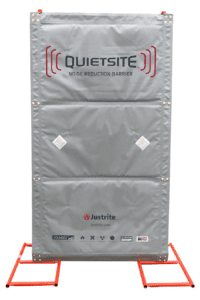
Blocking noise before it reaches people’s ears protects both workers and passers-by. Construction companies, like all businesses, are required to control noise. Non-compliance can result in hefty fines and potentially costly construction delays. Prefabricated panels like Justrite Quiet Site Noise Reduction Barriers absorb and deflect sound at the source, before it can cause damage. The 4-foot by 6-foot and 4×8 modular panels can be connected and configured in a variety of shapes to surround machinery or create a barrier wall between noisemakers and workers and the public. Foldable, stackable, and easily assembled, Justrite’s fire- and water-resistant barriers can be mounted on link fence, scaffolding, or steel frames.

Prolonged exposure to loud construction noises can cause permanent, irreparable hearing loss. Even noises that require workers a few feet apart to raise their voices to be heard are loud enough to cause damage. Contractors need to protect their workers, site visitors, and neighbors from the effects of noise pollution. Erect barriers to contain noise-generating equipment and provide workers with a variety of earplugs and earmuffs to ensure they can find a size and type that is comfortable and effective.

The Pro Group’s technical and sales team members are experts in local noise compliance regulations. Contact us for advice on the products and applications you need to implement a noise-reduction protocol to stay in compliance and protect the people at and around your construction site.

5 Summer Safety Tips for Construction Workers

The hot summer heat can make working uncomfortable. Without the right preparation and equipment, it can also quickly become very dangerous.

Heat exhaustion and heat stroke are not only uncomfortable, but can lead to serious illness or even death. Even less-serious overheating can lead to injuries and accidents affecting other construction workers and property.

As your job sites begin to heat up this year, it’s important to create an environment where construction workers are able to reduce the risk of overheating, heat exhaustion, and heatstroke.

Some methods and tools to keep in mind include:

1. Stay hydrated and have plenty of accessible drinking water

Staying well-hydrated is the body’s best defense against hot working conditions. On-site, make sure workers have ample water on hand, and are encouraged to drink throughout the day.

For long shifts, making sure everyone has a chance to eat is also important for hydration, since both water and salts are a necessary part of maintaining an electrolyte balance.

2. Provide shaded areas for resting

Making sure workers have a chance to avoid direct sun exposure during breaks helps to keep workers cool and prevent sunburn and heatstroke.

Having proper equipment and supplies, including cooler mesh gear where possible, sunglasses, and sunscreen are all also important tools.

3. Take constant breaks

Giving the body a chance to cool down during activity is key during hot weather. Continuous work in the heat is not advisable.

The CDC estimates the amount of break time needed depending on the environmental conditions, air temperature, and type of work being done – for example, doing moderate work at 101 degrees Fahrenheit typically requires 20 minutes of break time for every 40 minutes of work.

You can adjust the work/rest schedule to your worksite, but keep in mind that self-pacing alone may not be sufficient.

4. Learn to recognize the signs of heat-related illnesses

Heat stress is dangerous partly because it can come on suddenly – the person experiencing it may not realize what is happening. Making sure you and your workers know how to recognize signs of heatstroke and heat sickness, and what to do if someone has these symptoms, can be key to keeping everyone safe.

Some signs to look for include:

  • Confusion
  • Dizziness
  • Fatigue
  • Muscle cramps
  • Nausea
  • Headaches
  • Clammy, damp, or pale skin
  • Strange behavior or altered mental state
  • Panting/rapid breathing, rapid heart rate

If someone has these symptoms, they should stop working and seek medical attention immediately.

Some people may be at higher risk of heat-related illnesses due to their age, health history, or other factors.

5. When working indoors, make sure to use construction climate control

Being in an enclosed space can quickly make even mild days feel sweltering. Construction air conditioning and dehumidification are both essential to keep workers safe, cool and productive. The Pro Group carries a range of portable climate control options for sale and rental.

Construction dehumidifiers

Humidity is the presence of water molecules in the air. Warmer air can hold more water than cold air, meaning that warmer temperatures often mean higher indoor humidity.

Your body’s main defense against heat is to sweat, which works because water evaporating off your skin makes you cooler. If there is too much moisture in the air, more water will sit on your skin.

Construction dehumidification is already an important tool for many indoor jobsite environments since damp air can mean poorer drying and curing for many processes.  When it comes to heat protection, making indoor spaces dryer can also make the difference for worker safety.

The Pro Group carries several indoor dehumidification tools, including the DRI EAZ lgr 7000, which offers portable, high-performance water removal at rates of up to 130 pts./day. This option also offers a built-in self-monitoring system which make automatic fan speed adjustments over the course of the day.

Construction air conditioning

When keeping the air dry and moving isn’t enough, air conditioning can also be a helpful tool at keeping indoor spaces habitable.

Pro Tool also carries a number of air conditioning units to fit most indoor construction climate-control needs, including the Americool WPC-4000 which offers a powerful and effective cooling mechanism. This can be especially important in areas where heavy work is being done or surfaces get very hot to the touch.

The Pro Group is here to help you stay cool all summer

Preparing for rising temps is just good business. Climate control results in a safer construction site, but also a more efficient site – overheated workers have less energy and find it harder to concentrate. Keeping things cool is not only safer, but helps to keep projects on schedule.

For help finding the right climate control solutions for your team and your job, our skilled technicians are always on hand. Request a Quote or call us at 1-888-776-0007 to speak with a Pro Tool & Supply representative for more information on our stock of construction dehumidifiers, ventilators, portable construction air conditioners, and fans.

Keep Your Tools and PPE Safe with a Knaack Box

A well-organized workspace is one the most straightforward ways to improve productivity. In the best of times, keeping a neat space is key to driving efficiency. Having a place for everything also helps minimize the risk of misplacement and mistreatment of tools and equipment.

Given current CDC recommendations, worksites will also need to be prepared with adequate protective and cleaning gear to keep construction teams safe. OSHA requirements now also require that “To the extent tools or equipment must be shared” workers must be provided with  “alcohol-based wipes to clean tools before and after use.”

Tools will have to be regularly sanitized, with other protective equipment (PPE) such as masks, sprays, gloves, and wipes easily accessible so that construction teams can constantly sanitize their tools and protect themselves against the virus at all times.

Knaack boxes provide both easy-to-access cleaning supplies and a portable and secure way to store and organize equipment and PPE. Pro Tool carries many Knaack storage units to fit every construction crew’s needs.

Some of the tool chests we carry for improved gear accessibility and secure storage include:

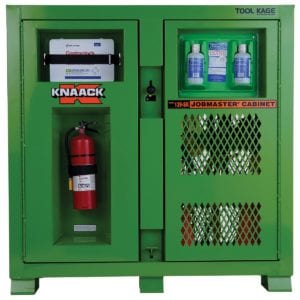
Safety Kage

The Safety Kage offers a ventilated, secure storage area for harnesses, first aid supplies, and other essentials on caster-ready skids. Its three-point latching and recessed handles allow for secure storage and allows workers to grip the container even (even with gloves on), while a foot latch allows for hands-free opening in all protective gear situations (this may be particularly important if sanitation is an issue, since minimizing touching surfaces helps prevent the spread of virus).

The durable steel mesh is weather resistant and allows for airflow, preventing the growth of mold and mildew, while the 18 hooks and 47.5 cubic foot capacity provide ample storage to protect harnesses and other gear from tears, weather damage, and loss.

There is also an easy-access first aid tool compartment for first-aid emergencies, and the interior shelves keep gear of a variety of sizes and shapes easily organized.

Model 44 Jobmaster

The Model 44 Jobmaster offers a rolling storage area with a solid top, for an easily-sanitized, durable, and

mobile workspace. At 40.6 inches wide, and with an 800 lb capacity, it can hold even heavy-duty equipment, with the inner drawers each rated to 50 lbs.

The left half of the box is open, allowing for storage of taller items, while the build-in rollers make it easy-to-access and mobile.

It also includes a powder-coat water and weather-resistant surface capable of lasting for decades, and the lid has a two-point recessed locking system to prevent break-ins.

For items that do not require ventilation, this is a durable, easily accessible and mobile workspace with built-in organization.

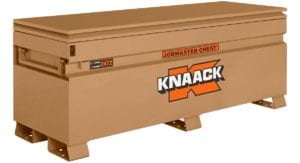
Model 2472 Jobmaster

knaack box

The 2472 Jobmaster chest is a versatile, secure organization solution, offering 24.5 cubic feet of storage and featuring a full-length piano hinge stacked and welded.

The lid offers quick and ergonomic access to gear, and the dampening spring can be easily opened from three sides. The Power Pass® Electrical Pass-Thru grommet enables quick, weatherproof power cord access.

Additionally, heavy-duty recessed side handles allow for enhanced mobility and protect the tool chest against damage during transport, while the WATCHMAN® IV Lock System provides unbeatable theft prevention. If you need more mobility, the tool chest can be easily and quickly equipped with rolling casters.

Organize your worksite PPE with a Knaack box

Safety equipment has quickly become an essential tool to keep workers safe and job sites open and efficient. Given the ongoing shortages and need to secure equipment safely, a Knaack box can be a great option to help many sites keep tools and equipment easily accessible and safe from the elements and from loss, damage, or theft.

Pro-Tool’s inventory of Knaack boxes includes many options to fit your specific sites’ needs to keep expensive tools, supplies, and equipment safe and easily accessible, and given the sturdy steel construction, they should last for years to come. Contact us for more information about our many Knack box offerings.

Construction Water Management Tools: Dewatering Pumps & Water Tarps

With April’s heavy rain season around the corner, almost all construction sites will require a dewatering system.

Whether your site is indoors or outdoors, water is one of the most common causes of damage (and one of the most popular types of construction insurance claims, only coming second to fire)

Excess water left standing on site can lead to erosion, falls, and damage to expensive materials, equipment, and supplies. On top of the equipment replacement, water damage can delay or interrupt projects, indirectly increasing costs.

Keeping your site flood-free is one of the most important safety steps, both for your crew and for your equipment.

It’s not possible to control the groundwater or the rain, but it is possible to efficiently manage excess water on-site with the use of water management tools.

Whether you need to lower the groundwater level, or just keep rainwater from collecting on your site, Pro Tool and Supply offers a number of water management options to fit your needs. we carry an assortment of high-tech dewatering pumps and water diverting tarps to help you keep your site safe, clear, and operating smoothly through whatever situation spring storms bring.

For example:

Tsurami electric dewatering pumps

For both indoor and outdoor use, electric pumps are ideal for dewatering construction sites, mines, or for all-around use in industrial plants and facilities.

Unlike gas pumps, electric pumps can be used indefinitely and plugged into a power source. Tsurami electric dewatering pumps can handle not only the water itself, but the mud, grit, and dirt that comes in with industrial water-removal situations.

The LB series fits into 8-inch pipes and is easier to use and maintain than gas-powered dewatering systems.

To set up, all that is required is a discharge hose. Because of its easy setup, this dewatering pump is able to quickly reach various flooded locations at your construction site for swift and efficient water removal, which means you’ll be back to work faster.

Strongman water tarps for liquid diversion

If your primary water management need is to protect equipment and sites from rainwater, a tarp may be your best option.

Water tarps such as the Strongman drainage tarp prevent leaks from flooding your site during a heavy rain. Unlike standard tarps, a heavier-duty construction tarp can be reused several times and has the durable hardware needed for safe construction use.

The Strongman tarp will attach to any standard garden hose, allowing for easy channeling of the water collected on the tarp. It comes in several sizes in order to fully cover your roof or equipment as needed, including standard 12’ by 12’ and 15’ by 15’.

It is also fire retardant for greater safety and peace of mind.

Construction water removal keeps sites high and dry in spring storms

For help finding the right dewatering system, learn how to choose the right pump for your site here.

As April approaches, water removal is essential for worker safety and to keep your jobsite running smoothly and efficiently.

Whether you need to rent a dewatering system or are looking for a complete tarp set to protect your gear and worksite, Pro Tool has everything needed to effectively remove water from a construction site.

At The Pro Group, we offer a wide selection of construction equipment rentals, including gas/diesel pump and electric submersible pump rentals from leading brands. Request a quote today or call us at 1-888-776-0007 to speak with one of our knowledgeable equipment specialists on our stock of dewatering pumps and our on-site construction equipment rental delivery options. We also offer dewatering pumps for purchase.

OSHA Compliant Silica Vacuums

Silica is one of the most common minerals found globally. Unfortunately, when it shows up in construction sites as an ingredient in sand, rock, concrete, mortar, and stone, it can also quickly become one of the most dangerous health concerns.

When workers cut, grind, saw, or crush these materials, it generates very fine crystalline silica powder which wreaks havoc on the lungs if inhaled. Silica exposure can then lead to chronic and serious illnesses, like:

  • Lung cancer,
  • Silicosis (an often fatal, incurable lung disease),
  • COPD (chronic obstructive pulmonary disease), and
  • Kidney disease.

OSHA Standards for Silica Dust Protection

Back in 2017, OSHA set a new, stricter standard for crystalline silica dust that cuts in half the previous limit. According to the standard,

“the employer shall fully and properly implement the engineering controls, work practices, and respiratory protection specified”

The penalty for not engaging proper protection also got a lot steeper: as of January 2020, a single violation costs over $13,493, with rapidly escalating fines for repeat offenses up to $134,937 per violation.

In other words, silica vacuums and other respiratory protection tools are not only important for worker health, but also to stay compliant and avoid a critical financial hit.

Pro Tool and Supply carries a number of top brands of OSHA-compliant silica vacuums

Per OSHA standards, if you’re using a dry system to capture dust from floor grinders, the vacuum requires a shroud firmly affixed to the bottom of the grinder to corral the dust, a vacuum powerful enough to suck up the dust, and a filter with 99 percent or greater efficiency and a cleaning cycle.

Pro Tool and Supply carries a range of top OSHA-compliant vacuums and silica dust removal systems to help you comply with the latest regulations.

We are also happy to speak with you directly to help identify the best solution for your needs.

Some of the top brands we carry include:

Dewalt

We carry two Dewalt model dust extractors, including the dwv012 model 10 Gallon extractor and the dwv010 model 8 Gallon HEPA Dust Extractor with Automatic Filter Cleaning.

Both models offer variable suction to control the vacuum’s power consumption and work in wet and dry applications.

This dust extractor is equipped with automatic filter cleaning functionality that pulses every 30 seconds for continuous operation without you having to stop to clean out the filter.

They also come with two HEPA filters and kink-resistant hose. The larger model offers 140 CFM of airflow for maximum suction, while the smaller model is lighter weight and offers 130 CFM.

Both have heavy-duty construction and a 360-degree swivel.

Bosch

Bosch air extractors offer convenient cartridge design to make filter installation extremely easy. We carry two model sizes, the vac013 and vac019. Both include a universal dust collection attachment and on-board filter cleaning, with a maximum of 150 CFM suction and 97 inches of static water lift. The on-board filter activates every 15 sections.

The included fleece filter bag helps to protect the filter and provides the optimal containment of dry dust and debris. The system is universal and is designed to connect to a vacuum so that it can be used with any size hammer and can accommodate the full range of drill bit diameters and drilling depth.

Wap Attix

The Attix 50 wet/dry vacuum cleaner (model 50 (900131h) is the latest compact generation of the Attix line (formerly called WAP).

These silica vacuums are favored by contractors for general clean-up, “at-the-source” dust control during sanding/drilling operations, offering 135 CFM and 92 inches of water lift, a quieter motor with a lower noise rating than other models, and a 12-gallon tank capacity. The Attix also includes a more ergonomic design and convenience features such as a built-in tool storage area on the cover.

Dustless

Pro Tool carries the Dustless Technologies (1606) Wet Dry HEPA 16gallon vacuum, which includes a Micro Pre-filter that extends the life of the filter and makes this vacuum more cost-efficient to use over time. The pre-filter captures particles down to 0.5 micron, before they hit the HEPA 0.3-micron filter, which therefore lasts up to 30 times longer.

The Dustless model also enables switching between wet and dry operation without stopping to change filters or make other adjustments. This vacuum emits only 81 dB of noise, and offers 126 CFM and 76.9 inches of water lift. A 16 Gal. Canister and Micro Pre-filter bag support optimum air flow while holding up to 40 lbs. of dirt and debris.

Husqvarna

Pro Tool also carries multiple models of dustless system vacuums from Husqvarna, including:

  • DC1400

A small and lightweight wet/dry silica vacuum, the DC1400 is perfect for dust control. It’s designed for use with the PG280 Grinder, but can also be used with hand grinders.

  • DC3300

The DC3300 is a single-phase dust extraction unit designed to accompany the Husqvarna PG 530 Grinder.

  • DC5500

The DC5500 is a more heavy-duty choice that’s ideal for use with any planetary grinder that needs a vacuum with high suction and flow to eliminate airborne dust.  The high CFM and large capacity enable it to handle all grinding and polishing applications.

Pro Tool’s Quality Silica Dust Vacuums Get the Job Done Safely

Finding the right OSHA compliant vacuum is essential both for the safety and health of your workers and for the sake of meeting stringent OSHA compliance standards.

Pro Tool offers the highest quality vacuums to get the job done safely and efficiently.

Still not sure which silica dust vacuum is right for you? Call The Pro Group at 1-888-776-0007 to speak with a representative who can help you find the right model for your needs, or request a quote here.

The Right Ladder for the Right Application: A Guide to Podium and Leaning Ladders

leaning ladder

Ladders are essential tools for worksite efficiency and safety. Since there are a large variety of ladder types, it’s crucial to select the most suitable model for your job and worksite.

Many pros build up a ladder collection overtime to meet OSHA requirements and have the best tools on hand for any given job.

Construction ladders should keep you and your workers safe while executing climbing tasks. Though they are a great way to increase access to higher-elevation locations, they can also leave workers vulnerable to falls, especially if the wrong type of ladder is used.

For example, some factors to consider include:

  • Height: For starters, ladders should be long enough to allow a 75.5 or smaller degree angle from the ground. If you’re using a basic step or extension ladder, you’ll need to account for this distance, and the maximum height someone can stand from the top of the ladder – a maximum safe reaching height is typically about four feet higher than the top of the ladder.
  • Strength: ladders typically come in five different ratings depending on the type of job they’re designed for. The “duty rating” is the maximum safe amount of weight the ladder can hold; remember that this number includes both the weight of the worker and any gear or equipment they’ll need to bring up the ladder or use while standing on it.
  • Material: Modern ladders are typically made from lightweight and durable materials like steel, fiberglass, and aluminum. If your worksite is outdoors, has the potential to be exposed to chemicals, or requires outside storage, then you’ll need to select a ladder suitable to handle those conditions. If you are working with electrical wires or might be exposed to electricity, it’s important to make sure the material is appropriate and the legs of the ladder are grounded or encased in non-conductive material.
  • Type: Specialty, extension, platform, and leaning ladders all have their time and place.

Werner offers a number of specialty and standard ladders for construction use, including podium and leaning ladders. Here’s a quick guide to how to choose between them:

When to Choose a Leaning Ladder

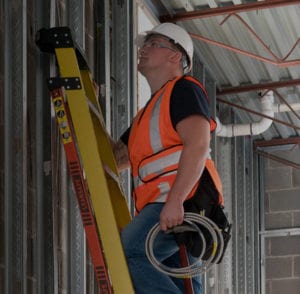
Leaning ladders are flexible options when you need to move to different locations quickly, need to access multiple heights, and don’t need to face multiple directions while working.

The Werner LEANSAFE models offer additional advantages such as built-in safety mechanisms which securely latch the ladder onto the vertical surface and reinforced rubber legs to prevent surface damage and provide a more stable platform.

It also offers a lower rear rail to front rail connection point allowing the user to get closer to the work when in stepladder mode.

The Werner LEANSAFE Ladder is available in lengths ranging from 4 through 12 feet in height and is rated up to 300 lbs. (1A Duty rating).

Unlike most leaning ladder styles, it’s also OSHA compliant – per regulations, traditional step ladders must be completely self-supporting. The LEANSAFE can be used as a stepladder, but due to its innovative supportive structure can also be safely leaned against a variety of surfaces.

When to Choose a Podium Ladder

If you need to work while standing on the ladder, or you want to face multiple directions, a platform-based ladder is the best choice.

Werner podium ladders have a standing platform at the highest safe standing level, allowing for more mobility and access in different directions. It also features an extra-wide standing area and secure guardrails with built-in locations for tools and supplies.

Podium ladders are best suited for working at fixed heights, especially in places where it would be difficult or impossible to maneuver a lift or install scaffolding. It comes in 3ft – 10ft models, all graded for heavy-duty construction use and rated to 300 pounds.

Leaning and Podium Ladders Improve Safety and Minimize Downtime

Smart ladder choice prevents worker falls and impact damage to equipment, while providing access to hard-to-reach places. While there are many choices out there, modern technology allows for a more secure and durable product to keep your worksite efficient and safe.

Pro Tool and Supply is ready on hand to help you find the right ladder option for any construction task: feel free to Contact Us for help or request more information about the ladders we offer.

Winter Weather Prep: A Guide to Ice Melt Products

Try to imagine living in a cold climate without ice melt products. One would have to carefully consider every single step taken when outdoors. It would slow everyone down quite a bit. And even then, there’s a strong chance of slipping or falling.

Thankfully, we do live in a world with ice removal products. Without them, life in the winter months would be quite different.

What Is Ice Melt?

Ice melt products help to prevent slipping and falling caused by ice and hard-packed snow that builds up on outdoor surfaces like parking lots and sidewalks as well as outdoor work areas. Using a professional grade of ice melt product both before and after sleet and snow helps keep everyone safe.

Ice melt for snow and ice is effective because when it is sprinkled on walkways it:

  • Prevents ice and snow from hardening
  • Turns existing ice into a liquid slush
  • Breaks the bond between ice and the walkway

The safest step is to put ice melt down immediately before snow or sleet starts falling. However, if you forget or miss an area, ice melt also works when you sprinkle it over ice and hard-packed snow that’s formed.

Many types of ice melt products are available, and we’re here to help you sort it out. These products are appropriate for sidewalks, driveways, steps, entryways, parking lots – even roofs!

What to Consider When Choosing an Ice Melt Product

Several factors influence what ice melt product you choose. There are many types of ice melt, and the most important considerations are:

  • Temperature
  • Area of application
  • Length of time needed

Temperature

It’s important to choose an ice melt for snow and ice that has the appropriate lowest effective temperature. If you work in a climate that experiences extremely cold temperatures, make sure you pick a product that’s rated to be effective in sub-zero temperatures.

Area of Application

Ice melt products have varying levels of corrosiveness that can damage concrete and metal. These products can also damage bushes and grass and end up in nearby waterways.

Length of Time Needed

Check to see how long the ice melt product remains effective after it has been applied. Some products are made of a proprietary blend of compounds that increase the length of time they work.

These products might be more expensive, but they can end up costing less over time because you don’t have to apply ice melt as often.

Ice Removal Products and Their Characteristics

The following products have been proven to work well when used in the recommended climate and environment:

  • Mr. Magic®
  • MAG® Chloride Flakes
  • Urea
  • Peladow™
  • Green Scapes™

Mr. Magic

The unusual orange color of the Mr. Magic pellets serves two purposes:

  • It lets passersby know that ice melt has been applied.
  • It lets you see where it has been applied so you don’t overuse it.

Mr. Magic is considered safe for concrete, brick, and decking. It’s also easier on the environment than many other products.

Mr. Magic works in cold weather as severe as -25 degrees Fahrenheit. It melts snow and ice quickly and works for a longer period of time.

MAG Chloride Flakes

Flaked ice melt products work better in certain situations than pellets. They lay horizontally and don’t roll, so they work well on sloped surfaces. In areas with high winds, flakes are less likely to roll away than pellets.

MAG’s Chloride Flakes and Pellets work in cold weather as severe as -27 degrees Fahrenheit and are less corrosive to metal surfaces and create less concrete spalling than many other ice melt products.

Urea

Known as a moderately effective ice melter, Urea is safe to use around vegetation as long as it’s not over-applied.

Urea doesn’t contain any calcium chloride, which can be corrosive. Because of this, it’s used often on concrete that has rebar and around steel structures.

Urea works best in moderately cold temperatures down to 15 degrees Fahrenheit.

Peladow

Made into pellets that are 90% calcium chloride, Peladow works well in nearly all cold temperatures down to -25 degrees Fahrenheit. One of the reasons it’s popular is that it doesn’t leave behind a residue.

Peladow pellets work well because their perfectly round shape penetrates ice and snow faster than irregularly shaped pellets. You can spread the pellets using a regular pellet spreader.

Green Scapes

Like Mr. Magic, the Green Scapes ice melt product is tinted to prevent over-application. Its green tint emphasizes its reputation as an eco-friendly ice melter. It can melt snow and ice in temperatures down to -10 degrees Fahrenheit.

Green Scapes is a blend of ice-melting compounds, one of which is magnesium chloride. The other chemical is ice ban, which is a natural, corn-based product.

Helpful Ice Melt Accessories

In order to increase the efficiency of spreading your chosen ice melt product, these tools can help get the job done easier:

  • Grain scoops—A scoop helps remove the ice melt from the bag or bucket more quickly and effectively than by hand. For small areas, you can use the grain scoop to scatter the pellets or flakes.
  • Ice melt spreaders—A pellet spreader tool is invaluable for applying ice melt pellets and flakes rapidly and evenly. For smaller areas, a walk-behind spreader works. If you have large areas to cover, consider a commercial-grade spreader.

Prevent On-the-Job Winter Slips and Falls

Working a winter construction job site requires some foresight to keep workers and visitors safe outdoors. Make sure you consider your snow removal needs and stock up on ice melt in advance. Don’t forget to check out our other winter construction equipment and tools.

Check out our selection of resources, tools, and equipment to make sure your workers and jobsite are productive and safe during the winter season.

The Pro Group is happy to work with you, whichever way is easiest:

A Guide to Construction Site Snow Removal and Protection

Cold temperatures can put workers at risk of fall or exposure injuries, and unexpected freezes can damage equipment or materials at your site. Some companies can shut down in the “off-season” until the last blizzard of the spring, but that’s not always possible or preferable.

In New England, removing snow can seem like a nearly full-time occupation come the first winter vortex.

Being able to protect your site, or thaw and remove snow and ice as quickly as possible, is key to protect employees, gear, and your site.

On top of the safety necessity of snow removal and protection, keeping it from piling up in the first place and removing it safely and easily can be a critical factor in preventing avoidable weather delays.

Site-Protection Tactics for the Winter

Protecting equipment, tools, and workers from the elements is an important first step. Taking basic precautions keeps costs down and helps to avoid unnecessary maintenance costs. For example:

  • Keeping equipment and tools inside when possible
  • Covering any outside equipment and tools with sheeting or snow tarps
  • Using antifreeze for any equipment and tools that need it
  • Making sure fluids in your equipment are rated for your area’s temperatures and replace if needed
  • Taking steps to warm up and test equipment and tools before use
  • Keeping sensitive materials, such as adhesives, concrete, shingles, paint, caulk, resins, and epoxies, inside or otherwise protected

Winter Accessories and Apparel

Outfitting your crew with appropriate accessories makes it easier for workers to handle equipment in the cold and prevents injuries and delays.

Before winter gets here, consider providing your crew with accessories such as:

  • Winter Jackets
  • Winter Gloves
  • Hard Hat Liners
  • Face Protection
  • Winter Work Boots

Job-Site Equipment and Supplies for Cold Weather

While often overlooked, ensuring you are prepared with the right supplies each winter keeps you from getting caught unawares by the first major storm. For example:

Snow Removal for Jobsites

Even with the best planning and gear, snow is often unavoidable in a lot of areas of the country. The Pro Group also carries a range of winter snow-removal equipment and supplies to aid with melting and removing snow as quickly as possible.

For example, for snow protection, we carry a range of ice melts.

For snow removal, we offer protective Eagle Industries Snow Removal Tarps, which can avoid hundreds of man-hours from manually removing fresh snow.

Before leaving the site, workers cover all equipment and working surfaces with the snow tarps. In the morning, small poly tarps can be lifted from the site by hand, while large poly tarps can be lifted via crane, quickly removing snow to prevent wasted time and energy.

For larger sites or when you need to move old snowpack, we also offer a range of snow movers and snow plow/pusher attachments.

Keep Your Jobsite Protected This Winter

The Pro Group has your winter jobsite protection needs this season to keep your site operating on-schedule and safely. Whether you’re interested in snow removal tarps or want to look into a variety of equipment, tools, accessories, and educational resources for winter construction, we’re here to answer any questions you have – contact us here.

We can set you up with the construction equipment and materials you need to work through the winter with a minimum of weather-related delays and hardships. Request a quote for rent or supply.

5 Methods for Maximum Floor Protection During Construction

Floor protection during construction gives everyone peace of mind. Using protective material on the worksite means that the crew can focus on the task at hand rather than worrying about damaging floors, cabinetry, countertops, or other surfaces.

Even if the flooring (or other surface material) is inexpensive, you must also consider labor costs for installation. Paying to replace damaged material plus labor is not an expense you want your business to experience if you can avoid it!

Although surface protection might raise your costs a bit, it helps to think of it as a type of insurance that protects your wallet, your schedule, and your reputation.

Considerations When Choosing Floor Protection

Construction Floor Protection

Before you can choose construction floor protection, you obviously have to know what you’re protecting. Nearly every type of flooring and decorative surface material needs protection:

  • Carpet
  • Granite
  • Laminate
  • Marble
  • Stone
  • Tile
  • Vinyl
  • Wood

Equally important to know is what you’re protecting against:

Dents

Dents can occur when a heavy tool is dropped onto a surface. Pushing a heavy dolly or cart across a surface can also dent materials.

Cracks

Harder materials like ceramic or stone tile are vulnerable to cracking from heavy objects that either fall or are moved across it.

Spills

Chemicals (including paint) that are spilled or splattered at the worksite can damage flooring beyond repair. Even water can cause damage, such as to wood flooring.

Scratches

Scratches can be caused when grit gets trapped under a moving object like a dolly or when tools and equipment are carelessly handled.

Scorches

If your worksite uses welding tools or blow torches, scorches can damage even the hardest materials.

Wrinkling

Carpets can become wrinkled if heavy objects are dragged or rolled across it.

Another important consideration when choosing construction floor protection is the length of time it’s needed. In general, you can tell by the thickness of the protective material whether it will endure a longer project. However, some thinner material can be quite durable, so ask a floor protection specialist if you’re unsure.

5 Methods for Maximum Floor Protection

Follow this checklist for floor protection during construction to guard against the most common forms of damage to floors and other surfaces.

Plan What Needs to Be Protected

Look over the worksite and determine three things:

  • What needs to be covered and protected — Make sure you think this through for every stage of the construction or renovation project.
  • What areas need to be sealed off — You can protect floors completely by blocking access with construction tape or safety netting/mesh.
  • How long it needs protection — The length of time you plan to be on the project for affects the type and durability of flooring protection needed.

Use Tape to Prevent Falls

Tape the edges of protective materials together to keep them from curling up and posing a tripping hazard. You should also ensure that the material doesn’t slide across the floor, which can damage the flooring beneath or cause a fall.

Determine Hauling Methods

Before starting the project, decide which types of dollies or carts you will allow inside the worksite. Having four-wheeled transport is better than two-wheeled, as the weight is distributed better and less likely to damage floors. For the same reason, wider wheels are better than thinner wheels.

Clean Floors and Other Surfaces

Before installing floor or surface protection, carefully sweep or vacuum up debris. If the surface has any sort of spill that’s dried on it, wipe it up so it doesn’t get sealed under the protective material and cause damage.

Buy Protective Material

Based on the flooring you will be installing as well as any other surfaces that need protection, purchase the material that best fits the project requirements. In general, protective material is made of:

  • Corrugated cardboard
  • Corrugated plastic
  • Hardboard
  • Plastic film, sheets, rolls, or mats
  • Rolled paper
  • Rubber sheets

You can also find a wide variety of protective material that uses different materials bonded together, such as rosin paper, fiberglass, and polyethylene.

Plasti-Shield Benefits

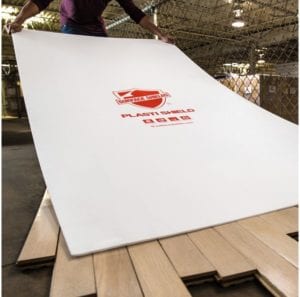
One type of material that can protect a variety of surfaces is Plasti-Shield™ from Surface Shields. Plasti-Shield is a type of corrugated plastic that’s lightweight, but also strong, durable, and impact resistant. Its many benefits include:

  • Available with a fire-retardant additive
  • Cost-effective
  • Cuts easily with a utility knife
  • Reusable to help cut construction costs
  • Water and chemical resistant

Installation is simple, as all that’s needed to seam the edges together is blue tape.

Flooring Protection Help and Quotes

Starting a new construction or renovation project without having floor/surface protection on hand can lead to damaged material and higher labor costs. But with the right planning and the practical steps mentioned in this article, you’ll be covered (pun intended)!

Whether you’re interested in Plasti-Shield™ from Surface Shield or want to look into a variety of surface protection materials, The Pro Group is happy to answer any questions or give you a quote.

Search For Products

Product has been added to your cart